100th

MP


THE 100th MONKEY PRESS
Ex Scientia Adhevo Sapientia

Home

Contact Us


Book Store

Limited Editions by Aleister Crowley & Victor B. Neuburg


Bibliographies

» Aleister Crowley
» Victor B. Neuburg
» Frater Achad


Download Texts

» Aleister Crowley
» Victor B. Neuburg
» Frater Achad


The 100th Monkey


WANTED !!NEW!!


What's New


ROSA MUNDI


»» DOWNLOAD TEXT ««


Image
Thumbnails

Title:

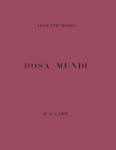
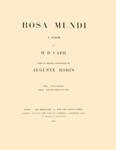
Rosa Mundi.  A Poem by H. D. Carr with an Original Composition by Auguste Rodin.


Cover


Lower Cover


Title Page


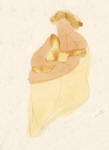
Frontispiece

Print
Variations
:

State (a):

Printed on Japanese vellum.
Bound in rose-colored wrappers.
Upper cover lettered in black ‘AUGUSTE RODIN | ROSA MUNDI | H.D. CARR’.
Lower cover has a vignette design. 
12 7/8” x 9 13/16”.

 
Publisher: Philippe Renouard / H. D. Carr.  
Printer: Philippe Renouard.  
Published At: Paris / London.  
Date: 1905.  
Edition: First Edition, Second Impression.  
Pages:

vii i+ 20.

 
Price:

Priced at 20 francs / 16 shillings.

 
Remarks:

Published under the pseudonym of H. D. Carr.
The frontispiece is a color lithograph of executed by Auguste Clot after an original pencil and wash design by Auguste Rodin.
The frontispiece is the same as first edition, first impression but is on thick glossy paper.

 
Pagination:
Page(s)  
[i-iv] Blanks
[  v] Half-title (Same as first edition, first impression but has the additional text ‘PRIX:  VINGT FRANCS  PRICE:  SIXTEEN SHILLINGS NET’
[  vi] Edition and limitation notices
[  vii] Title-page
[  viii] Blank
[1-15] Text
[  16] Blank
[  17] Colophon ‘PRINTED BY PHILIPPE RENOUARD | 19, rue des Saints-Pères | PARIS’
[18-20] Blanks
 
Contents:


Author’s
Working
Versions:


Other
Known
Editions:

+

The Collected Works of Aleister Crowley, Vol. III, Page 51, Society for the Propagation of Religious Truth, Boleskine, Foyers, Inverness, 1907.

+ Ambergris, Page 130, Elkin Matthews, London, 1910.
+ Selected Poems, Page 28, Crucible, London, 1986.
 

Comments by
Aleister
Crowley:

     I gradually sickened of the atmosphere of Paris. It was all too easy. I flitted restlessly to London and back, and found no rest for the sole of my foot. I had even got engaged to be married, but returning after a week in London I was partly too shy to resume relations with my fiancé, and partly awake to the fact that we had drifted under the lee shore of matrimony out of sheer lack of moral energy. This lady claims notice principally as the model for several poems, notably (in Rosa Mundi, and other Love Songs) “The Kiss”, “Eileen” and the poems numbered 14, 15, 16, 18, 21 to 28. She was also the “Star” in The Star and the Garter, Which I wrote at this time; and the three women connected with the “Garter” were an English lady with a passion for either, an acrobat and model whom I called my boot-button girl because her face was “round and hard and small and pretty”, and thirdly Nina Olivier. Nina is described in the poem itself and also in several lyrics, notably “The Rondel”—“You laughing little light of wickedness”. My adoration of Nina made her the most famous girl in the quarter for a dozen years and more. She figures, by the way, in my “Ordeal of Ida Pendragon”.
     — The Confessions of Aleister Crowley.  New York, NY.  Hill and Wang, 1969.  Page 355.

______________________________
 

     Jan. 1st.
     Began badly: missed dear and hare. So annoyed. Yet the omen is that the year is well for works of love & union; ill for those of hate. Be mine of love!
     This entry does not sound as if I were still wholly lunatic in the rays of the honeymoon. The explanation is that the mere fact of getting back to camp life reawakened in me the old ambitions and interests. It may be part of my feeling for ritual that to put on certain types of clothes is to transform my state of mind. However lazy I may be, I have merely to change trousers for knickerbockers to feel athletic at once. There is also the point that I make a profession of virtue when reminded of certain dates, just as a totally irreligious man might go to church at Christmas. The subsequent entries give no hint that my mind was really turning to its ancient masters. The sole entries concern sport and camp life; and they are very meagre.
     I have never been able to enjoy reading chronicles of slaughter, and I do not propose to inflict any such on the world. They are as monotonous and conventional as those of mountaineering. Sportsmen and climbers follow the fashion with frightful fidelity. Norman Collie wrote the only book on mountains which possesses any literary merit. Mummery’s is good because he really had something to say, but his style shows the influence of Collie. Owen Glynne Jones produced a patent plagiarism of Mummery’s style; and when it came to the brothers Abraham, the bottom was reached. And what a bottom! In fact, two.
     Of the older writers, Leslie Stephen is the only one worth mentioning, and to him mountaineering was of secondary interest. Tales of hunting, shooting and fishing are equally tedious. They are only tolerable in fiction such as Mr. Jorrocks and The Pickwick Papers. Travelers having wider interests are more readable. Sir Richard Burton is a supreme master; the greatest that ever took pen. He has not one dull paragraph. Cameron and Mary Kingsley must not be forgotten for a proxime assessit.
     Certain incidents of this shoot are worth passing notice. Rose had an attack of fever on the seventh of January. For the first time since my marriage I had a moment to spare from celebrations of Hymen. I sat at my camp table in my Colonel Elliot’s chair and wrote the poem Rosa Mundi, the first for many months. I sing to her, recall the incidents of the birth of our love, hint at the prospect of its harvest, and weave the whole of the facts into a glowing tapestry of rapture. It was a new rhythm, a new rime. It marks a notable advance on any previous work for sustained sublimity.
     Physically and morally, Rose exercised on every man she met a fascination which I have never seen anywhere else, not a fraction of it. She was like a character in a romantic novel, a Helen of Troy or a Cleopatra; yet, while more passionate, unhurtful. She was essentially a good woman. Her love sounded every abyss of lust, soared to every splendour of the empyraean. Eckenstein adored her. When I published this poem, which I did privately under the pseudonym of D. H. Carr, from the feelings of delicacy, Eckenstein was actually shocked. He did not care much for my poetry as a rule; but he thought Rosa Mundi the greatest love lyric in the language. (As a cold fact, its only rival is Epipsychidion.) But he held it too sacred to issue. “It ought,” he said, “to have been found among his papers after his death.”
     I can understand the sentiment of this view, but cannot share it. I wanted to make humanity holier and happier by putting into their hands the key of my own success.
And in my diary there is no allusion to the poem. (It may in fact have been written during an earlier illness of rose—on December 15th—but I don’t think so, because I connect the inspiration with eating buffalo steak, and on the earlier date I was only eating snipe.) I have only noted, “Rose ill, one bloody birdling, bread arrived in P.M.”
     — The Confessions of Aleister Crowley.  New York, NY.  Hill and Wang, 1969.  Pages 374-375.

 
Reviews:


Home

Contact Us


Copyright © the 100th Monkey Press - 2008