100th
MP

|
THE
100th
MONKEY
PRESS |
|
|
|
Limited Editions by Aleister Crowley & Victor B. Neuburg |
|
Bibliographies |
|
Download Texts
»
Aleister
Crowley
WANTED !!NEW!!
|
|
AMBERGRIS |
|
»» DOWNLOAD TEXT «« |
Image |
|||||||||||||||||||||
| Title: |
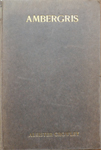
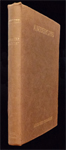
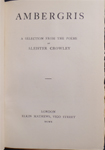
Ambergris. A Selection from the Poems of Aleister Crowley. |
|
||||||||||||||||||||
|
Print |
|
|||||||||||||||||||||
| Publisher: | Elkin Matthews, Vigo Street.3 | |||||||||||||||||||||
| Printer: | Strangeways Printers, Great Tower Street, Cambridge Circus, W. C.2 | |||||||||||||||||||||
| Published At: | London.3 | |||||||||||||||||||||
| Date: | 1910.3 | |||||||||||||||||||||
| Edition: | 1st Edition. | |||||||||||||||||||||
| Pages: |
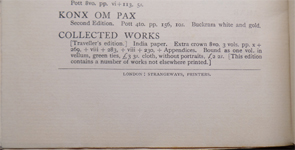
viii + 198 + 2 pages of advertisements.1 |
|||||||||||||||||||||
| Price: |
Priced at 3 shillings and sixpence.2 |
|||||||||||||||||||||
|
Remarks: |
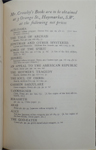
Tipped in as a frontispiece is a photogravure of Aleister Crowley, New York, 1906.1 Some copies have a erratum slip stating “Mr Crowley's Books are to be obtained at the office of the 'Equinox.' 124 Victoria Street, London, S.W.” tipped in facing p. 198.4 |
|||||||||||||||||||||
| Pagination:1 |
|
|||||||||||||||||||||
| Contents: |
From ‘The
Tale of Archais’ |
|||||||||||||||||||||
|
Author’s |
||||||||||||||||||||||
|
Other |
|
|||||||||||||||||||||
|
Bibliographic Sources: |
|
|||||||||||||||||||||
|
Comments
by |
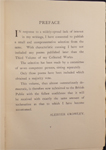
In response to a widely-spread lack of interest in my writings, I have consented to publish a small and unrepresentative selection from the same. With characteristic cunning I have not included any poems published later than the Third Volume of my Collected Works. The selection has been made by a committee of seven competent persons, sitting separately. Only those poems have been included which obtained a majority vote. This volume, thus almost ostentatiously democratic, is therefore now submitted to the British Public with the fullest confidence that it will be received with exactly the same amount of acclamation as that to which I have become accustomed. — Preface, Ambergris, Elkin Mathews, 1910. |
|||||||||||||||||||||
| Reviews: |
It is perhaps not uncharacteristic of the poet of these verses that he should give them a title which has really but little connection with them. A certain perverseness or wilfulness is manifest in much of his work, and surprise and paradox are effects which seem dear to him. For these poems are of Grecian rather than of Arabian or Persian origin, and the fragrance of Ambergris is a much lighter and more spiritual thing than the rich and arrogant perfume of Arabia. Maybe Mr. Crowley so entitled his poems, as one christens a child Rose or Wilhelmina or Théophile, without any descriptive or moral intentions at the back of one's mind. Maybe, he just fell a victim to the charms of a pretty word, as any susceptible poet might, and made her forthwith the doorkeeper of his poetic seraglio. Perhaps it was not worth writing, since he who can afford to be vain can afford to forego the demands of his vanity, yet there it is, and of itself it would make one wonder if the author of Ambergris and some thirty other volumes had any right to be piqued because he is not as well known and as well acknowledged as he would like to be. A glance through his press notices convinces one that there is at least a chance that he has such a right He has been roundly condemned, treated to impertinence, and in some cases extravagantly praised, but no one seems to have given him that deadly kind of appreciation which is the lazy critic's heart-felt thanks that there is nothing to criticise. Nobody has called him a classical poet, or "one who is preserving the best traditions of our noble heritage of song," or assured him that he is " of the true succession," or anything of that kind. This shows that there is, at least, a fair chance of his being a good poet, though of course it does not prove it, for it is possible for a man to be a very bad poet and yet not be praised by the Weary Willies of academic criticism. A first glance at Ambergris shows Mr. Aleister Crowley as perhaps the most passionate disciple poet ever had. Such imitation of Swinburne's manner, as is revealed in most of his early work, could only have been born of the strongest love for the champing colourous rhythms of the Victorian. By itself, for the passion which inspired it, it commands respect. But there is too much of such work included here. It prevents access to what is strong and personal in the book. It shows a passion which was one day bound to define itself in letters of original flame. It prophesied, but a sceptical world only believes such when they come true. That something has come true in our poet's case will be admitted, I think, on reading Alice:
The stars are hidden in dark and mist, The moon and sun are dead, Because my love has caught and kissed My body in her bed. No light may shine this happy night— Unless my Alice be the light.
This night—O never dawn shall crest The world of wakening, Because my lover has my breast On hers for dawn and spring. This night shall never be withdrawn— Unless my Alice be the dawn.
Mr. Crowley is very successful in this kind of thing. These love-songs of his have a wonderful ardour, an almost Sapphic fury. They flash and shine with images that are like little streaks of flame. Sometimes, though, he is more delicate and more ethereal as in the following verse from Red Poppy:
One kiss like snow to slip Cool fragrance from thy lip To melt on mine; One kiss, a white-sail ship To laugh and leap and dip
Her brows divine; With love of a sweet saint Stolen like a sacrament In the night's shrine.
The verse with which the book opens is a beautiful stanza. It has all the hard brilliance and the lustre which are characteristic of the writer's work. The opening picture breaks on the senses like a shaft of sudden sunshine.
Ere the grape of joy is golden With the summer and the sun, Ere the maidens unbeholden Gather one by one, To the vineyard comes the shower, No sweet rain to fresh the flower, But the thunder rain that cleaves, Rends and ruins tender leaves.
Among many things that occur to one in reading Mr. Crowley's verses is their singular disseverance from the things of the day, their entire lack of what is called "the modern note" in poetry. Of course such a devotion as in his early work he gave to Swinburne, Browning, and Shelley would not allow him to serve other masters. We must think that he deliberately shut his eyes to the writings of the intimate, romantic, impressionist school, or else how could so susceptible an artist have escaped its infection? Another thing that is apparent in this poet's work, despite the cumulative effect of his poems, is the fitfulness of his inspiration. His gift, splendid as it appears at times, is unique and occasional rather than rich and sustained. A journey through the garden of the poet's verses has all the excitement and the drawbacks of making one's way by means of the illumination of lightning. There is a lot of darkness to a small proportion of extreme brilliance, though, perhaps, as with all rare and superfine things, this is necessarily the case. It is their price I will now take some single images or metaphors from the poems and place them by themselves. It is in these things and by their quality that the poet is shown. Is this not natural, for what is art after all but one vain adjective for ever seeking its impossible noun? What is all poetry but one imperfect metaphor, an analogy made with one of the comparisons only half guessed at through Eternity's veil? Observe the tremendous compression of thought in the lines, where the poet speaks of old love buried and seemingly forgot, rising up and breaking out from
. . . the untrusty coffin of the mind.
Again, what a delightful picture is suggested in the
winged ardour of the stately ships.
How closely those two words winged and ardour are bound! Welded in the original passion of creation, they hold their idea with a noble security. Criticism cannot sunder them. Beautiful, too, I fancy are the lines:
To some impossible diadem of dawn.
The trampling of his (the sun's) horses heard as wind.
My empire changes not with time. Men's Kingdoms cadent as a rime Move me as waves that rise and fall.
Of poetry Mr. Crowley says:
Thou art an Aphrodite; from the foam Of golden grape and red thou risest up Immaculate; Thou hast an ebon comb Of shade and silence, and a jasper cup. . . .
This, of a lady:
So grave and delicate and tall— Shall laughter never sweep Like a moss-guarded waterfall, Across her ivory sleep?
There are some noble and vigorous images scattered among Mr. Crowley's verses, whose invention alone marks him out as no inconsiderable poet. For the rest, great metrical force, rhythms so violent as almost sometimes to exhaust themselves, and, in some of the later work, a curious employment in his philosophy of paradox—that Mr. Facing-Both-Ways of literary effects. I will end on a lighter note, and quote the beautiful and tender song from The Star and the Garter. Is there not in it a reminiscence of all the beauty of our lives that has passed like water through the helpless senses? Is there not a certain very fairy and frosty note in this song, such as—to be ridiculously fanciful—an elf might make with a rose-leaf and a fretted mandoline of hoar-frost, something cold, yet warm at heart, like a very lovely yet unreachable lady, the lovelier for the pedestal of snows on which she is set?
Make me a roseleaf with your mouth, To some far garden of the South, The herald of our happening there!
Fragrant, caressing, steals the breeze; Curls into kisses on your lips:— I know interminable seas, Winged ardour of the stately ships. —The English Review, December 1910 by Edward Storer (An alias of Aleister Crowley?).
______________________________
This book appeared in the summer of 1910. Since that time Mr. Crowley has come into greater prominence, not so much as Frater “Perdurabo,” but more as the writer of some sound prose and fine commentary criticism. He is outliving his inane attempts to reform the world by false magic, and his truer magic, his poetry, is gaining in influence. The present collection is a good and for the most part pleasing one, but we are quite sure the committee of which each member sat separately for the making of this selection did not include any maiden aunts. If so, the piece, “The Reaper,” would not have been reprinted, nor “The May Queen.” Parents of impressionable young ladies, please note. “The Goad” is a fine and inspiring piece, pleasantly reminiscent of Keats, and the first song is a splendid piece of word music. —The Poetry Review, January-June 1914. ______________________________
“In response to a widely-spread lack of interest in my writings, I have consented to publish a small and unrepresentative selection from the same,” says Mr. Aleister Crowley in the preface to “Ambergris” (Elkin Mathews). I surmise that one reason for the widely-spread lack of interest in Mr. Crowley’s admirable verse has been the price of it. Thus “Rosa Mundi,” a quarto pamphlet of seventeen pages, is sold at 16s. Perhaps I ought to say it is offered. Happily “Rosa Mundi” is included in “Ambergris,” and a fine poem it is. Mr. Crowley is one of the principal poets now writing. Yet if any mandarin had to write an article on our chief living poets he would assuredly not mention Mr. Crowley. I doubt if he would mention Lord Alfred Douglas, who has, I imagine, produced immortal things. On the other hand he would not fail to speak at length about Mr. Laurence Binyon, with extracts! Why are Mandarins thus? —The New Age, 13 April, 1911. ______________________________
A very casual glance at “Ambergris” will convince any one with understanding eyes that Mr. Crowley is as passionately possessed by his theme as any poet has been. This must ensure a constant achievement of notable poetry. . . . Mysticism is Mr. Crowley’s theme. Precisely what species of mysticism he professes, or rather, for all mysticisms are fundamentally the same, into what shape of metaphors and symbols Mr. Crowley has fashioned his mysticism, we do not stop to determine. Its importance to him is immense; it is the hinge of his whole thought. To us, its importance is simply that it carries him often into excellent poetry. The main intellectual passions which move him will be familiar to all who have studied writers tinged or impregnated with mystical and transcendental thought. . . . Enough has been said to show that Mr. Crowley’s “Ambergris” is a volume containing notable poetry. —The Nation, date unknown. ______________________________
You may call the poem “Wedded,” and choose some stanzas:
The roses of the world are sad. The water-lilies pale, Because my lover takes her lad Beneath the moonlight veil. No flower may bloom this happy hour— Unless my Alice be the flower
So silent are the thrush, the lark! The nightingale’s at rest, Because my lover loves the dark, And has me in her breast. No song this happy night be heard— Unless my Alice be the bird.
The sea that roared around the house Is fallen from alarms, Because my lover calls me spouse And takes me to her arms. This night no sound of breakers be— Unless my Alice be the kiss.
This night—O never dawn shall crest The world of wakening, Because my lover has my breast On hers for dawn and spring. This night shall never be withdrawn— Unless my Alice be the dawn.
This is extracted from “Ambergris, a selection from the poems of Aleister Crowley” (Elkin Mathews)—the most interesting volume of new English verse seen this year. Crowley was met years ago in “The English Critical Review,” and has occurred here and there since, seeming always extraordinary. He is extraordinary—in his work, in the fine portrait affixed to his work, and in his preface. The little volume of 200 pages, at 3s, 6d, is commended as a pleasure to every amateur of poetry. One does not remember any verse so plastic as some in the earlier pages of “Ambergris.” Crowley writes shapes, beautiful shapes, beautiful coloured shapes like chryselephantine statuettes. All readers of verse know that there is ear-poetry and eye-poetry—poetry that sounds well and looks ill, and poetry that looks well and sound ill. Crowley makes an unusual appeal both to eye and ear. His ivory shapes go singing themselves golden tunes. In particular he has a gift of good beginnings, he attacks admirably. If form were all! Crowley fails in emotion: his verse does not yield that ecstasy that adds the last drop to the brimming vase. He is always evident, never ineffable. Nor, although original, is he highly, compellingly original; he does not lead us to unfooted fields of dream; at most he finds a new path in the familiar territory. Yet to call him “minor” is to do him injustice; he has the voice, though not the great imagination; and his skill with lines and rhymes, words and phrases, is more than craft. He is not “minor” because he has a pulse and a strong opinion; he does not flutter, he soars. Soars best when closest earth: his abstractions are empty: he needs the living model to inspire his art. Then with a puff from swollen Eros:
One kiss, like snow, to sip, Cool fragrance from thy lip To melt on mine; One kiss, a white-sail ship To laugh and leap and dip Her brows divine; One kiss, a sunbeam faint With love of a sweet saint, Stolen like a sacrament In the night’s shrine!
One kiss, like moonlight cold Lighting with floral gold The lake’s low tune; One kiss, one flower to fold, On its own calyx rolled At night, in June! One kiss, like dewfall, drawn A veil o’er leaf and lawn— Mix night, and morn, and dawn, Dew, flower, and moon!
There are many Shakespearian touches in Crowley, and not so many Shakespearian lapses. If you stress the lapses, he gives a line for maltreating—
Smite! but I must sing on. . . What a motto for our Australian bards, ifray!
Accept Crowley or refuse him, he brings his own atmosphere, and captivates you, and finally captures: there is such a tide of life in him, though it does not rise through the finest poetic brain (nor did Shakespeare’s tide). And for closing, let the Star-Goddess sing a stanza of Orpheus dead—and risen.
For brighter from age unto age The weary old world shall renew Its life at the lips of the sage, It’s love at the lips of the dew. With kisses and tears The return of the years Is sure as the starlight is true.
There is one that hath sought me and found me In the heart of the sand and the snow: He hath caught me, and held me, and bound me, In the lands where no flower may grow, His voice is a spell. Hath enchanted me well! I am his, did I will it or no. . . . —The Evening Post, 17 December 1910. ______________________________
. . . There is life and vigour and reality in it,
and a personality sincerely
expressed in spite of
what appears to be willful eccentricities. ______________________________
Ambergris. A Selection of Poems by Aleister Crowley. Elkin Mathews. 3s. 6d. Printed by Strangeways and sons, Great Tower Street, Cambridge Circus, W. C. We don’t like books of selections, and you can’t make a nightingale out of a crow by picking out the least jarring notes. The book is nicely bound and printed—as if that were any excuse! Mr. Crowley, however, must have been surprised to receive a bill of over Six Pounds for “author’s corrections,” as the book was printed from his volume of Collected Works, and the alterations made by his were well within the dozen! [Yes; he was surprised; it was his first—and last—experience of these strange ways.—ED.] If poets are ever going to make themselves heard, they must find some means of breaking down the tradition that they are the easy dupes of every— [Satis.—ED.] Just as a dishonest commercial traveller will sometimes get a job by accepting a low salary, and look for profit to falsifying the accounts of “expenses,” so—— [Here; this will never do.—ED.] We have had fine weather recently in Mesopotamia—[I dare say; but I’m getting suspicious; stop right here.—ED.] All right; don’t be huffy; good-bye! —The Equinox, Volume 1, Number 4, S. Holmes (Aleister Crowley), September 1910. ______________________________
You may call the poem “Wedded,” and choose some stanzas: The roses of the world are sad, The water-lilies pale, Because my lover takes her lad Beneath the moonlight veil. No flower may bloom this happy hour— Unless my Alice be the flower.
So silent are the thrush, the lark! The nightingale’s at rest, Because my lover loves the dark, And has me in her breast. No song this happy be heard— Unless my Alice be the bird.
The sea that roared around the house Is fallen from alarms, Because my lover calls me spouse, And takes me to her arms. This night no sound of breakers be— Unless my Alice be the sea.
Of man and maid in all the world Is stilled the swift caress, Because my lover has me curled In her own loveliness No kiss be such a night as this— Unless my Alice be the kiss.
This night—O never dawn shall crest The world of wakening, Because my lover has my breast On hers for dawn and spring. This night shall never be withdrawn— Unless my Alice be the dawn. A Novel Preface.
This is extracted from “Ambergris, a selection of poems of Aleister Crowley” (Elkin Mathews)—the most interesting volume of English verse seen this year. Crowley was met years ago in “The English Critical Review,” and has occurred here and there since, seeming always extraordinary. He is extraordinary—in his work, in the fine portrait affixed to his work, and in his preface. "In response to a widely spread lack of interest in my writings I have consented to publish a small and unrepresentative selection of the same. With characteristic cunning I have not included any poems published later than the third volume of my collected works. The selection has been made by a committee of seven competent persons, sitting separately. Only those poems have been included which obtained a majority vote. This volume, thus almost ostentatiously democratic, is therefore now submitted to the British public with the fullest confidence that it will be received with exactly the same amount of acclamation as that to which I have become accustomed."
"A Book of Verse."
The little volume of 200 pages, at 3/6, is commended as a pleasure to every amateur of poetry in Australia. If you would have more, the author flaunts his opulence in two pages of final advertisement, where twenty-eight published items are offered in Japanese vellum wrappers, and in green camel's hair wrappers and in blue wrappers and orange wrappers, at £2 2/ each or less—a poetical bargain counter. Rosa Inferni, for instance, in 8pp. royal 4to and an orange wrapper costs only 16/—or 2/ per page—although a lithograph from a water-color by Rodin is added. Crowley is a devotee of Rodin, and deserves to be. One does not remember any verse so plastic as some in the earlier pages of Ambergris. Crowley writes shapes, beautiful shapes, beautiful colored shapes like chryselephantine statuettes. All readers of verse know that there is ear-poetry and eye-poetry that sounds well and looks ill, and poetry that looks well and sounds ill. Crowley makes an unusual appeal both to eye and to ear. His ivory shapes go singing themselves golden tunes. In particular he has a gift of good beginnings, he attacks admirably:—
Rain, rain, in May. The river sadly flows . . .
Sing, happy nightingale, sing; Past is the season of weeping . . .
In middle music of Apollo's corn She stood, the reaper, challenging a kiss . . .
She fades as starlight on the stream, As dewfall in the dell . . .
More Than Craft.
If form were all; Crowley fails in emotion: his verse does not yield that ecstasy that adds the last drop to the brimming vase; he is always evident, never ineffable. Nor although original, is he highly, compellingly original; he does not lead us to unfooted fields of dream; at most he finds a new path in the familiar territory. Yet to call him "minor" is to do him injustice; he has the voice, though not the great imagination; and his skill with lines and rhymes, words and phrases, is more than craft. He is not "minor" because he has a pulse and a strong pinion; he does not flutter, he soars. Soars best when closest earth: his abstractions are empty; he needs the living model to warm his art. Then with a puff from swollen Eros:—
One kiss, like snow, to sip, Cool fragrance from thy lip To melt on mine; One kiss, a white-sail ship To laugh and leap and dip Her brows divine; One kiss, a sunbeam faint With love of a sweet saint, Stolen with a sacrament In the night’s shrine!
One kiss, like moonlight cold Lighting with floral gold The lake’s low tune; One kiss, one flower to fold, On its own calyx rolled At night, in June! One kiss, like dewfall, drawn A veil o’er leaf and lawn— Mix night, and morn, and dawn, Dew, flower, and moon! Crowley has travelled, and writes harmonious stanzas for Hawaii, for Egypt, even for Hong Kong. Perhaps after Verhaeren (for we catch an echo here and there) he cries:—
To sea! Before us leap the waves; The wild white combers follow. Invoke, ye melancholy slaves, The morning of Apollo! . . .
The ship is trim; to sea! to sea! Take life in either hand, Crush out its wine for you and me. And drink, and understand!
Or.
The spears of the night at her onset Are lords of the day for a while, The magical green of the sunset, The magical blue of the Nile. Afloat are the gales In our slumberous sails On the beautiful breast of the Nile.
Exulting Vitality.
A little precious, Crowley must not be deemed to pose, despite his preface: often it is the excess of exulting vitality that is called a pose by timid little people. Admit, though, that this excess here and there arouses the comic spirit, as when the poet reviles his Muse in face of his Lady:—
Ye unavailaing eagle-flights of song! Of wife! these do thee wrong.
Thou knowest how I was blind; How for mere minutes they pure presence Was nought; was ill defined; A smudge across my mind, Drivelling in its brutal essence, Hog-wallowing in poetry, Incapable of thee.
Yet, a few lines below:
O thou! didst thou regret? Wast thou asleep as I? Didst thou not love me yet For, know! The moon is not the moon until She hath the knowledge to fulfil Her music, till she know herself the moon.
There are many Shakespearian touches in Crowley, and not so many Shakespearian lapses. If you stress the lapses, he gives a line for maltreating—
Smite! but I must sing on. . .
What a motto for Australian bards, Ifray! Accept Crowley or refuse him, he brings his own atmosphere, and captivates you, and finally captures: there is such a tide of life in him, though it does not rise through the finest poetic brain (nor did Shakespeare’s tide). And for closing, let the Star-Goddess sing a stanza of Orpheus dead—and risen.
For brighter from age unto age The weary old world shall renew Its life at the lips of the sage, Its love at the lips of the dew. With kisses and tears The return of the years Is sure as the starlight is true.
There is one that hath sought me and found me In the heart of the sand and the snow: He hath caught me, and held me, and bound me, In the lands where no flower may grow, His voice is a spell. Hath enchanted me well! I am his, did I will it or no. . . —Daily Herald, 10 December 1910.
|
|||||||||||||||||||||