|
ASTOUNDING SECRETS OF THE DEVIL WORSHIPER’S MYSTIC LOVE CULT by
Originally published in the November 1939 edition of SENSATION: The New Tabloid Magazine.
Revealing the details of Aleister Crowley’s unholy rites, his power over women, his weird orgies and his startling adventures.
Beast or poet? Monster or moralist? Genius or madman?
These are questions Europe asked for years about Aleister Crowley, one of the most complex characters in the modern world and one of the most extraordinary in human history.
ALEISTER CROWLEY, already notoriously famous in England, Europe and the Orient—called by his friends and enemies everything from “immortal genius” to “inhuman monster”—arrived in America from nobody knows where.
He may have come from a cell in some Chinese Buddhist monastery—from a tent in the middle of the Sahara—from a scholarly library in London—or from an opium dive in Montmartre.
They were all equally his “home”.
My first glimpse of this man who has been described as a “poet, mystic, mountain climber, big game hunter and general lunatic”, came at a very social party a few years ago at the Metropolitan opera.
Crowley appeared during the first entire-set intermission. He gave the impression of a punctiliously correct Britisher in conventional evening clothes—a big man of heavily athletic build, who looked as if he had spent most of his life outdoors. But the conventionality was only on the surface. On being presented to each member of the party, instead of murmuring the usual, “How do you do?” he said:
“DO WHAT THOU WILT SHALL BE THE WHOLE OF THE LAW.”
And thereafter, for the entire evening, he sat like an incarnation of Buddha, staring straight before him, saying nothing at all. The women of the party, I noticed, seemed strangely fascinated by this man—a fascination mingled with a sort of repulsion and fear. Their eyes were on him more than on the stage. He paid no more heed to them than if they hadn’t been present. At the end of the evening he said.
“Every man and woman is a star.”
He said it precisely as you would say “Goodnight,” or “It has been a pleasure to meet you,” and quietly he took his departure.
My next meeting with him was an experience which left a more indelible impression on my brain than the most vivid and fantastic novel I have ever read.
It began in Crowley’s New York studio, then at No. 1 University Place. Imagine an immense room hung with Oriental tapestries, enormous divans on the floor covered with dull cloth-of-gold, eastern images and idols and statues everywhere—some exquisitely beautiful, some hideous beyond belief.
Imagine a cosmopolitan gathering of a dozen men and women, invited by Crowley, “for afternoon dinner coffee and an evening of conversation.” Imagine Crowley himself, in a coat and trousers, made in pajama style of very heavy corded silk, swathing him in Black, sombre as a priest.
That night Crowley was brilliant, witty, talkative. The only person who did not join in the general talk was a girl between twenty-five and thirty, names Lea Hirsig, pretty but dressed with the utmost quietness and dignity, with a face that seemed a bit sad, a bit disdainful. I learned afterward that she was a teacher.
After a time, this girl added a few words to the conversation, and as she began to speak a remarkable change came over Crowley. I was watching his face, and it became, as you have seen the faces of actors become, the face of a man I had never seen before. I do not mean anything supernatural, but a kind of power blazed from it.
“You have spoken,” he interrupted, and curiously enough, his voice was a monotone like her own. “You have spoken, but I am Baphomet, and by my power your dead soul shall wake. You are Lea the Dead Soul. You shall become Lea the Scarlet Woman.”
Her answer came like a dash of cold water in the tense silence:
“Mr. Crowley—I believe that is your name—you are absurd. You have no power over me. I am not interested in your absurd pretensions.”
Crowley was now standing, looking down at her. He stretched out his arms and began to recite in some curious Hindu dialect. It lasted less than a minute.
Not another word did he speak to her the entire evening. The guests, including myself, left about midnight—all except Lea. Without a word to Crowley, and without a word of explanation, she simply stayed. Four days later I went back to see Crowley. I was drawn by an irresistible curiosity. I did not believe in magic. And you can interpret the events as you please, calling it hypnotism, charlatanism, as you like. I shall merely resound them.
Crowley’s big studio was on the main floor. The street door was opened by a porter. I knocked on Crowley’s own door. “Who is it?” I told him. The voice said. “Come in.”
The door yielded to the simple turn of the knob, and the scene that greeted me was so amazing that I might not now believe the evidence of my own eyes if there were not others—reputable people in New York—who know it to be true.
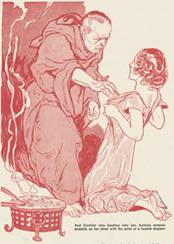
Lea, the “Dead Soul,” was kneeling in the center of a chalked circle, in the middle of the floor. She was barefooted, like a penitent nun, clad only in a loose robe drawn back over her shoulders, and Aleister Crowley was bending over her—burning magical symbols on her chest with the point of a heated dagger!
Why didn’t I interfere? Why didn’t I call the police? The girl was not bound, not held in any physical way. If she wanted the scene interfered with she could have stopped it by raising her voice—once.
I looked at her face. She was not drugged. She was not in a stupor. She was obviously in pain. But it was equally obvious that she was—where she wanted to be. An amazing thing in the New York of the twentieth century. But there it was. And it was her affair and his.
The girl must have suffered, but she did not make a single murmur until he was finished. Then, with his help, she got to her feet and retired to an adjoining room.
Though I wanted to ask a thousand questions I asked none. At the end of an hour Lea emerged, calm, smiling; talked interestingly on more or less ordinary subjects, and said when I left, as if her permanent union with Crowley was a matter of course: “I hope you’ll drop in often to see us again.”
I did see her often after that living like a queen or princess of the Arabian Nights on a great cloth-of-gold divan in Crowley’s studio—dressed in a robe of purple silk, her little white feet encased in slippers of scarlet vaire.
“I am happier that I ever dared to hope,” she told me. And as you reflect on Crowley’s mystical adoration of Lea you may think that any romantic girl might be intrigued and pleased by such wooing. But wait.
One afternoon I visited Crowley’s study. This time the door was locked, but he let me in. In the center of the room was an enormous easel, so massive it was almost a scaffold. And bound to this easel, facing it, was Lea—fastened by the wrists and ankles, her arms outstretched like a woman crucified, her dress stripped from her shoulders, her white flesh criss-crossed with red stripes.
Seeing my amazement, Crowley greeted me with a diabolical grin and tossed a broken dog-whip into the corner. “I have been awakening the Dead Soul,” he explained cheerfully. “She doesn’t object. If you are troubled with chivalrous scruples, you can ask her. Permit me to explain that the efficacy of pain as a spiritual stimulus is a subject misunderstood and neglected by modern woman. Sit down.”
And while Lea stood there, still bound, like a picture of some unwritten martyr, Crowley calmly made me a learned discourse on the importance of asceticism and whipping and fasting.
If I convey the idea that Crowley was occupying himself with the domination of one woman, I am giving you a wrong picture. The man’s energy was terrific. At this period he was writing, painting and bringing under his psychic influence, in one way or another, may women, some of whom were destined later to figure in his strange career.
I have told you that I could produce the evidence of reputable witnesses to substantiate the extraordinary facts of Crowley’s unbelievable career. One of these witnesses was Harry Kemp, famed poet and novelist, who has actually attended and seen with his own eyes one of the Satanist ceremonials.
Here is how Harry Kemp describes the “Black Mass” which he watched while sitting beside the “high priest” in Crowley’s studio.
“Suddenly the flame of the single candelabra that lighted the place went out, and there was a subterranean noise like the sound of a violent wind moving innumerable leaves. Then came the monotonous chant of the ‘high priest’: ‘There is no Good; Evil itself is Good.’ I could hardly believe my eyes as I observed what followed.
“Amid floating clouds of nauseating incense, a great crystal sphere rose slowly from the floor, and from it ascended a shape like a white puff of cloud. It wafted off, alighting on the floor and assumed the form of a diminutive nude black being. Other clouds arose, to materialize in the same manner. These were supposed to be the incarnations of evil spirits. In absolute nudity, they wove a grotesque dance in the gloom to the music of a hidden drum and flute.
A woman cried out hysterically. Tearing off her mask, she revealed the fair face of a girl of pure Anglo-Saxon beauty. She was quickly led away and the other worshippers began to moan and sway. The candelabra suddenly became lit again. Aleister Crowley, in the role of the ‘high priest’ stepped forward to the altar, from which he took a short, curiously shaped knife. His eyes bloodshot and stony, he began gashing at his chest. His disciples came forward and he made a mystic mark in blood on each of their foreheads as they knelt.
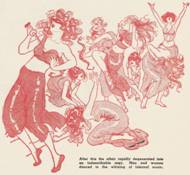
“After this, the affair rapidly degenerated into an indescribable orgy. Men and women danced about, leaping and swaying to the whining of infernal and discordant music. The moral ideas taught for centuries were thrown to the winds. All I desired was to escape unobserved.”
I quote Harry Kemp because his corroboration will help you to believe the even more startling revelations I have to make about this hidden sect. More startling? Yes! Because Harry Kemp did not see the real “Black Mass”, the amazing ritual which is the central ceremonial of the Devil-Worshippers the world over.
I have seen the real “Black Mass.” I have studied its ancient origins.
Imagine a large studio, hung with black curtains to represent a chapel. The “worshippers”, men and women, in black hoods, are seated as solemnly, on benches, as if they were in a real church ready to hear a real service.
At the end of the room, hidden by a veil, is the “altar”, a wooden block about four feet high and three feet across the top, covered with black velvet. Lying upon this altar is a girl, nude.
Her head thrown backward at right angles to the body, her arms and streaming blonde hair hang down perpendicularly along the right side of the block; and her lower limbs, bent at right angles at the knees, hang down the left side. She lies motionless in the dim light, like a figure out of marble.
The girl is beautifully formed, apparently nineteen or twenty years of age. I do not know who she is. I do not think I have ever seen her before—or that I shall ever see her afterward.
As if in a trance, she lies motionless while violins play and the “priest” intones his profane ritual, the worshipers joining in the responses.
At the culmination of the “Black Mass”, the “priest” lifts a golden cup, drinks wine from it, and sprinkles a little on the girl’s body, where it gleams like tiny drops of blood on the white skin.
The girl lies motionless on the “altar”, untouched by the “priest” throughout the ceremonial. The curtains are drawn and the abominable performance is ended. This is the real “Black Mass”. No “magic”, no orgies. Unholy, blasphemous, but quiet and solemn.
The orgy which Harry Kemp witnessed, and at which I was not present, was a different sort of ceremonial. The only part of his evidence which I have found it difficult to reconcile with the facts—in the light of my intimate knowledge of Crowley’s practices—is his description of the materialization of the dancing figures of evil spirits. I have seen Crowley try to do that—and fail. Perhaps he didn’t expect to succeed. One never knew when the real mystic ended and the charlatan began. He sincerely believed that he was able to invoke demons and spirits and actually make them do his bidding—but he declared to me that he had never been able to make them physically visible. I asked him outright about the materializations Harry Kemp described, and Crowley admitted that they were illusions—partly explained by the hypnosis of the spectators and partly by tricks which Crowley had learned during his long stay in India.
Nevertheless, Crowley’s command of powers of some kind is a fact admitted both by his followers and his enemies.
In the next chapter I shall tell how I became acquainted in New York with Leila Waddell, who had been the “high priestess” of Crowley’s cult in England, and how I learned more of its mystic séances and alleged “crucifixions.”
(To Be Continued in the December Issue.) |